
Jalan Jalan
Meandering about without a specific plan in mind

Earlier this month our family moved into a house on the border of two quiet(ish) beachside villages, Seseh and Cemagi. The house is an old joglo (traditional Javanese style structure) full of creaky floors and aging wood. The previous occupant, an elderly Italian woman with excellent taste, left us a few gems of falling-apart furniture, which we are trying to restore and make our own. Much of this entails scraping out rotten wood, killing termites, and using epoxy to patch furniture together like a crazy quilt.
The defining features of the joglo are its high ceilings and large windows that open up to a lovely garden full of palm trees, bamboo, and bougainvillea. The garden also contains three small cottages—called gladaks—an onomatopoeic reference, I am told, to the sound of hammers clacking away at the wood used to make these one-room structures. Traditionally gladaks were portable wooden houses, sometimes used as nuptial chambers, designed to be easily dismantled and moved to a new location. The ones in our garden are firmly fixed in place and in varying states of disrepair. Much of our time and resources are now devoted to putting them back together so they may one day be used as bedrooms.


In the meantime, we are camping out in the main room of the joglo, using boxes and piles of clothing to carve out private spaces for sleeping and working. It’s an excercise in patience and also a reminder of how little one actually needs to live comfortably.
Back in July, when we were still in Minneapolis, I thought it was imperative to pack up and ship to Bali boxes of artwork, books, ceramics, cooking pots, linens, rugs, and other personal items which our family has collected and treasured over the years and which defined, in my mind, our home. The items filled a partial shipping container and arrived three months later by sea to a port in Surabaya where the boxes then sat for another few weeks—soaking up tropical humidity and acquiring an unfortunate muskiness—before finally being delivered to us in Bali.
By that time, I had forgotten nearly everything we had packed and realized pretty quickly that most of these “necessities” were unnecessary for daily life. Now cleaned and stacked in neat piles around the joglo, these lovely things—the material evidence of our lives over the last several years—contain memories and stories, but also taunt me with their superfluousness. Plus, they remind me of the two storage units (!) full of furniture and other lovely things that didn’t make the must-ship-to-Bali list which are waiting patiently for us back in Minneapolis. Home, not home.
A short walk from the joglo are several dozen rice paddies that stretch southward toward the ocean. The fields are irrigated by a complex subak system that brings water from narrow channels and disperses it in a maze-like grid. Yesterday afternoon Sanjit and I went for a sunset stroll along the small concrete path that bisects several fields. In Bahasa we call this kind of walk jalan jalan, which means “to explore” or to go on a meandering adventure without a specific plan in mind. We did, in fact, have a goal for our jalan jalan: to check out a banana flower that Sanjit had seen the day before and assess how much progress—if any—the plant had made over the course of another sunny, hot day on the island.
The subak path was remarkably busy. Farmers tended to their fields. A few bules jogged, earbuds in place. Locals commuted home on their two-wheelers. A pack of cute dogs followed us for a bit, keen to play. Several young kids flew kites, then tied them off on a nearby tree to head inside for dinner. An old man with a toothless grin bathed in a particularly deep section of water. The breeze from the sea was strong and refreshing; it effectively wiped away the stresses of the day and reminded me how blessed we are to live here.


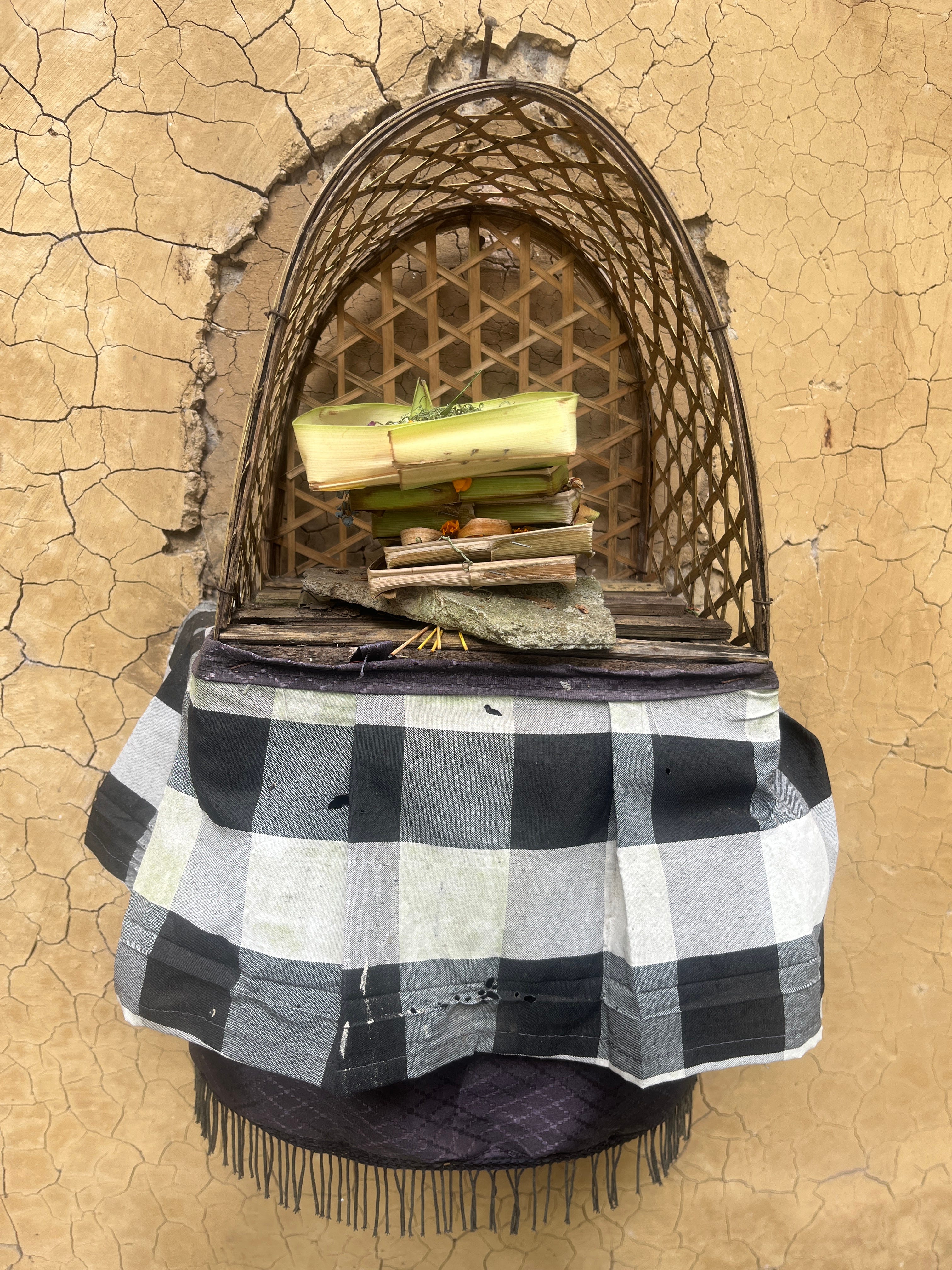
I keep returning the poleng pattern that I see everywhere in Bali: placed on shrines, wrapped around trees, and draped on bodies as sarongs. A seemingly simple black and white checker pattern, as you might encounter on a chess board or gingham dress. But the poleng is anything but simple. It symbolically contains the duality of life and the necessary opposing forces that we all experience: light/dark, hot/cold, joy/sorrow. It is balance, but also tension.
The steady repetition of the black/white squares and the subtle gray sections in between create space for all of my competing emotions. It holds both the sadness of missing my former home in Minneapolis and the community I left behind when I moved to Bali, while also allowing for feelings of gratitude for the new community I am creating here and the opportunity to restore a beautiful old joglo as our family home. It represents the fear of the unknown and the uncertainty of the future, while at the same time embracing the excitement and possibilities of what is to come.
When I was about five years old my mother and I took a clay class at Barnsdall Art Center in Los Angeles. As a child and a young adult I spent a lot of time at Barnsdall, taking all sorts of classes—from puppetry to life drawing to painting. What I remember most from the clay class was our final project. We were tasked with creating a three-dimensional sculpture of an animal. This assignment would consume the last few weeks of class and involve not only designing and fashioning an animal from clay, but also glazing and firing it.
For my animal, I chose a tiger, which was really more of a bizarre mashup of an actual tiger I may have encountered at the zoo and a cartoon version of a cat, complete with purple fur and oversized paws. It was wonky. Lumpy and disjointed. I remember struggling with the clay—it didn’t perform as I wanted. My tiger never quite looked the way I imagined it in my head.
My mother, meanwhile, fashioned the most beautiful looking elephant I have every seen. Anatomically correct, with smooth skin and a glorious trunk. I was in awe of her talent, her precision, and her ability to create something so perfect with the lumpy clay we were given. Instead of envy, I felt immense pride in my mother’s artistry, and also joy in the idea that the perfect elephant—once completed—would be living in my house.
You can perhaps imagine what happened next. Both the wonky tiger and the perfect elephant went into the kiln, but only the wonky tiger came out. The elephant exploded. Something about an air bubble. My five-year-old self was devastated. My mother could not have cared less. She was over-the-moon-enchanted by my wonky tiger, which she helped me mount onto a piece of wood, like a pedestal for a real sculpture, and then proudly displayed on a shelf in her office for many years to come.
I have been thinking a lot about the wonky tiger and the perfect elephant. We can plan and work hard and try to control the outcome, but sometimes things explode in the kiln. Sometimes termites have eaten through the wall of a gladak, leaving only a wooden shell behind. Sometimes the paradise where you think you are moving is actually one of the most challenging places you have ever been—testing your health and patience, and upending everything you thought you knew about the world.
The wonky tiger and the perfect elephant are also perhaps a bit like the poleng pattern: necessary bedfellows that keep us in balance and encourage us not to give up, not to get too stubborn, and not to hold on too tight; but instead, allow us to endure the messiness, uncertainty, sadness, and imperfection of life alongside all of the beautiful possibilities.
P.S. We did see the banana flower, btw, and it was glorious!


This is such a rich experience of all that you are touching, feeling and seeing and perhaps seeking.
Keep going friend. I love it. Xx